Does anyone here has experience playing both Erae 2 and Haken Continuum? I always wondered how they compare when it comes to sensetivity, particularly when it comes to velocity and pressure. Actually, i would love to hear from anyone who played more than one MPE device on how they compare to each other when it comes to sensitivity.
Hi,
I have a page dedicated to these questions.
It is in French and focuse on spatial gestures, but may give some ideas.
http://sonsdanslair.fr/controleurs.htm#pression
I have an Erae 2 and a friend has a Slim70 which I was able to try a few times.
The pressure sensitivity is good in Erae 2 but still far from Continuum or Sensel Morph.
The worst for me is the gesture sampling rate which is the fastest in Continuum.
The Sensel Morph and the Linnstrument are also excellent, but the Erae 2 is comparativeli sluggish, making fast attacks controlled by pressure impossible.
4 Likes
Very interesting website, and i found your video on the topic very comprehensive. Thanks for this!
its often hard to compare controllers as they take very different approaches:
- price / budget
- sampling rate & resolution
- travel on surface
- layout - linear / grid / keyboard
- size of surface
- continuous or discrete
- material / construction of surface
velocity is an odd one for all expressive controllers - sure, velocity is dZ / dT, so they all have it.
but the surfaces, means its not a traditional ‘percussive’ velocity. its often used differently (same with note off velocity)
I’d echo @PrS based on what Ive played…
Id add Osmose and Eigenharp’s as the same/close as Continuum.
for me thought, its not about specs, and measurements, but how it feels.
with the right combination of Surface and Sound, does it feel like your playing a physical instrument? - for the ‘top tier’, I think you do.
the ones below, have something that can break that slightly - perhaps a bit of hesitancy, unpredictable, just odd quirks, that break the ‘illusion’
but lets be clear…
with practice, Imost expressive controllers Ive come across you can get some great results out of, as you can learn their quirks, or even ‘play into them’.
the soundplane is a great example of this.
as a generic all rounder, you can quickly say, nah its too slow…
but have for a a while, a few years, you find the right sound, and it very much becomes an instrument 
also, Id say, we now have a lot of MPE controllers that are ‘hybrids’ or are trying to offer much more flexibility than ‘just a playing surface’ - the Erae is a great example, and Push3.
its understandable, MPE is still ‘niche’, and even in the mass controller market people want more… (e.g. sequencers, daw integration etc)
and that understandably means compromise, esp at a price point.
so yeah, I love my Osmose/Eigenharps for their expressiveness,
but I also love / appreciate my Erae 2, its MPE is fine for most things, and its nice to have something thats more portable and flexible - oh, and I like isomorphic controllers that are fully continious too 
3 Likes
Yeah, i agree on the non-linearity of this apples to oranges comparison. I was just wondering about how different controllers approach sensing, and what upsides and downsides this yields. As far as i can tell, Erae is sensetive enough when it comes to sensing gestures like pitch bends and timbral changes(though, pressure is arguably not perfect, especially when gliding over notes.) Like, i’d imagine Continuum’s hall sensors work better, since they sense magnetic field from rather far.
2 Likes
yeah, its an interesting topic… one that is particular pertinent to the Erae
I think with the Erae (1 & 2) its not so much about sensitivity (they are sensitive), but rather consistency across the surface.
they improved this for Erae 2, but its undoubtedly still not as consistent as Continuum/Osmose/Eigenharp.
the soundplane, (different tech gain) could at times suffer similar issues.
but I think the Erae’s trouble here is likely a few factors:
- calibration - Ive no idea how the Erae is calibrated to take into account differences between units caused by manufacturing variations.
- the travel and force required on the Erae for pressure changes is probably the ‘finest’ of all of these… so tiny changes in your finger pressure as you slide have a larger effect…
(the continuum has the largest travel of them all)
we know Haken/Osmose/Eigenharp ‘factory’ calibrate, and the Soundplane has a ‘calibration’ options (imprecise as it is)
Im sure Erae must calibrate the surface too, but its is odd that these variations exist, if they do a factory calibration over the whole surface, you can offset different sensor gains on a unit, and on different units.
the ‘gotcha’ is, if those gains change due to environment conditions e.g. temperature, or are not consistent (e.g. depends on how many touches you currently have and where they are)
really, we’d need someone from Embome to explains whats going on, they obviously understand the challenge well enough, as they ‘battled’ with it for Erae 1 → Erae 2.
does it matter? I think it depends on play style / use-case.
if you use a standard isomorphic grid (as I do), then it doesn’t seem be a major issue (unlike the erae 1) , so a bit like the Soundplane - I guess, its just a ‘characteristic’
I’ll say, given my experience with the Erae 1, whilst Id hope Embodme can make small improvements to this on the Erae 2. Im pessimistic that they’ll ‘perfect’ it.
so I have limited ‘expectations’, though ofc, Id loved to be proven wrong !
for me, perhaps the frustrating bit here, is Embodme are not communicative, or transparent.
I’d probably be ‘more forgiving/accepting’ if they explained the challenges in detail, and talked about how they mitigate them, but cant 100% fix it.
though, perhaps thats just me… I can imagine for many/most, they dont care and just want it to work … and thats fair enough.
1 Like
ok, interesting, Embodme did respond to our discussion on discord…
tl;dr; they are saying its caused by dust and that you can clean it
so indeed an environmental factor…
I need to try this, as its true I don’t remember this being obvious when I first got the Erae 2, as I tested it quite explicitly… and I do live in area prone to dust (low humidity etc)
Embome post from discord:
Hi, Yes, this is caused by dust trapped under the sensor sheet. Here is a short video showing how to clean it: https://www.youtube.com/watch?v=EDNkta0jqLk If it doesn’t improve, send it back to us and we’ll take care of it. To be fully transparent: because the surface is so sensitive, no two Erae respond exactly the same. Tuning it is a balance between raising the detection thresholds and keeping the response even across the whole surface, and the firmware runs a lot of auto-calibration, filtering and interpolation in the background to get there. Tell us how it goes after the cleaning!
Fix Weak Detection
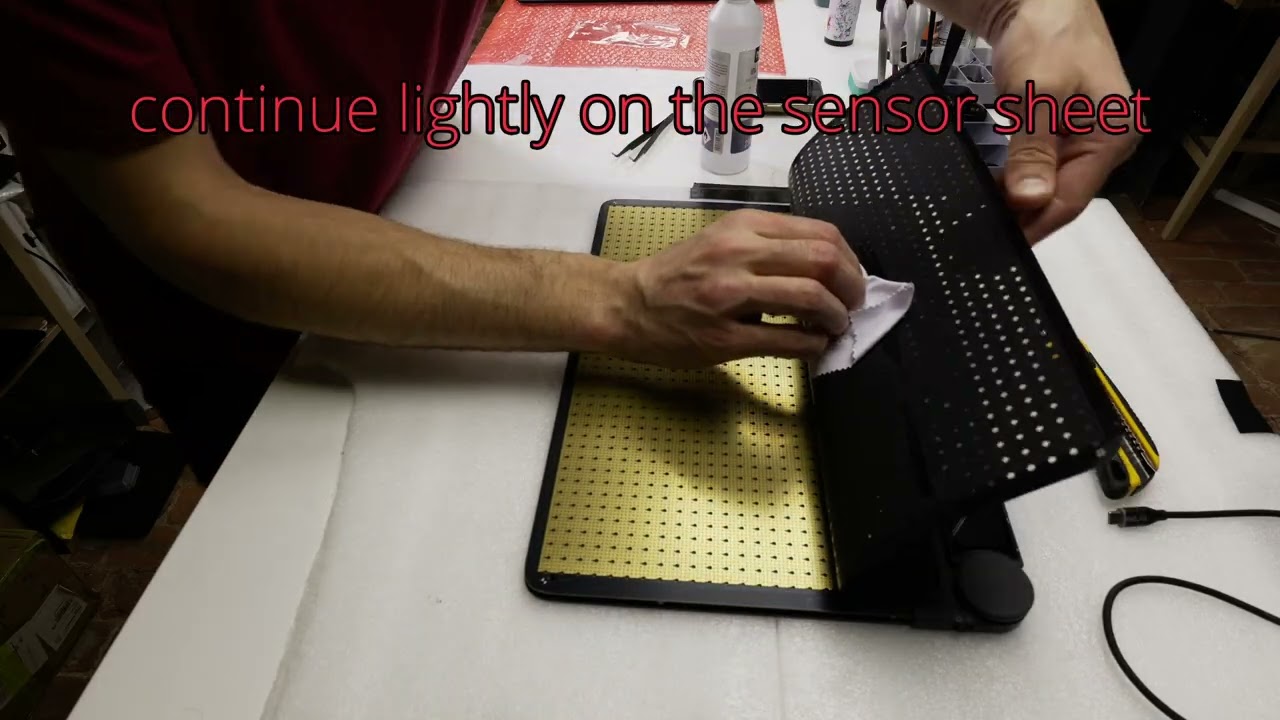
2 Likes
To me it becomes harder and harder to play on Erae 2 the more fingers i put on the surface. Sevenths are very hard for me, since i have to engage pinky finger. It is probably a skill issue, but an issue nontheless. Besides, when playing chords sometimes some notes are flickery.
Also, this video gave me the heebie jeebies when they pulled sensor sheet away from the board. I know it’s brobably safe, but it still sent a shiver down my spine xD
It is comforting to see that one can disassemble and clean the Erae2 relatively easy. Much harder (but possible) on e.g. Continuum and absolutely not recommended on Eigenharps (as the recalibration tools needed were based on some machine that only Eigenlabs has).
Adapting to the possibilities of the instrument sounds like a good plan. I e.g. have spent a lot of time with the Casio keyboard of my grandparents as a child. And that one didn’t even have velocity sensitivity
1 Like
I suspect with chords its a combination of both, irregularities in surface and also practice to put even pressure on all fingers (as the pinky is much ‘weaker’).
is more fingers causing it, Im not sure, when I use both hands, I don’t see it…
I don’t really see it as an issue with chords, as you are part of the feedback loop, just need to be careful with minimum pressure limitations.
but indeed, your timbre slide is a bit different…as you already have a given pressure, and want to maintain it.
one thing I have noticed, Embodme love animations , it makes it look cooler.
but things like the halo really exaggerate the differences (more than the sonic impacts its having) - Ive moved to glow on element colour, much more subtle - and really Im considering turning off all together
similarly, Ive changed element to brightness = 20, so its a subtle effect when you ‘activate’ a pad.
note: Im not saying the audio effect is not present , rather the non-glow styles are visually telling your brain its worst - imo
yeah, me too… I think it was the warnings about damaging the sensor sheet, and the using a blade to peel it back 
usually, these dangers are overplayed , to encourage people to be careful.
it did look like the sheet was pretty rigid, so I think its not that difficult.
that said, honestly, seeing it be taken apart, I find it hard to believe dust is going to get in there…it look well sealed at the edges.
100%