Stepan.engineer MPE keyboard retro-fit

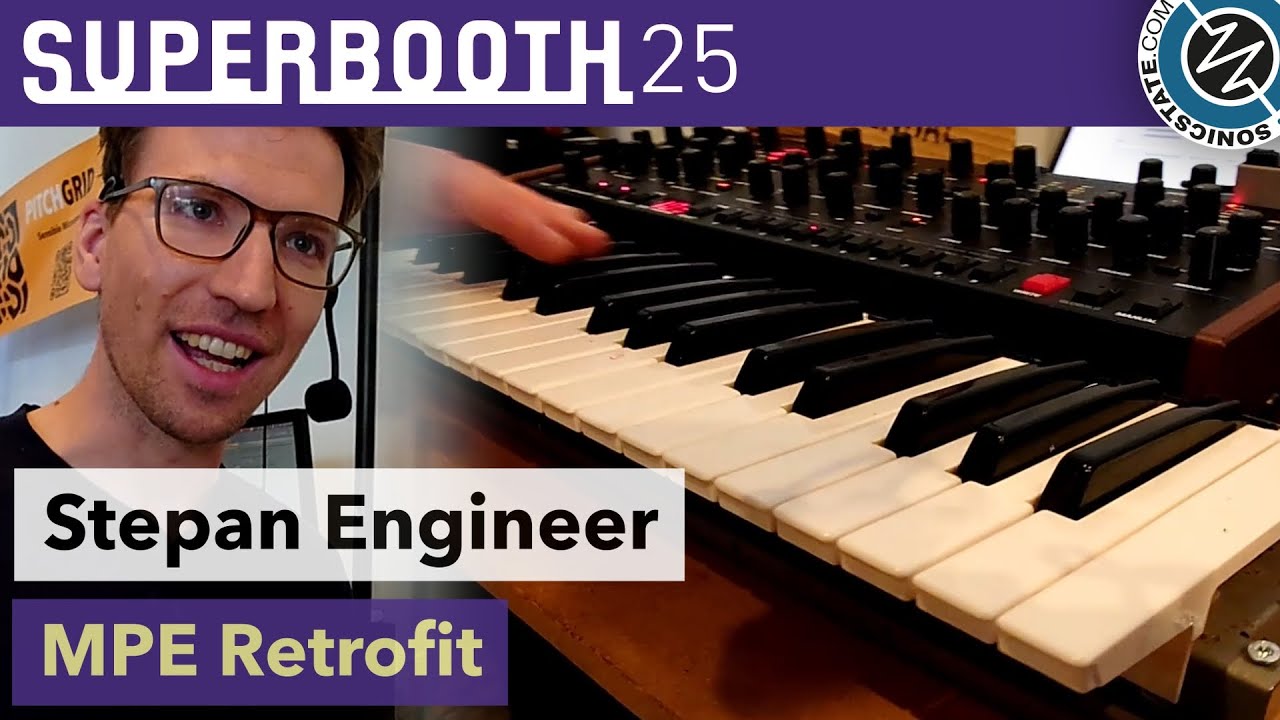
It looks like there is a new hardware option available for keyboard players (or synth makers) who like to get into MPE. As I understand it, stepan.engineer makes “.keyboard”, a custom PCB running MPE-capable firmware that fits into a Fatar keybed octave. It can also be retro-fitted into existing synth keyboards.

Definitely an interesting development, and nice to know that there are still new MPE designs coming out.

I am curious if it somehow can do per-note pitch bend, which is a big part of MPE. I am guessing no…

1 Like

More options are always nice!
You could retrofit the x/y dimensions with Touchkeys. But that seems to be about 200€ per octave alone, so with these two together we are getting into ranges where the Osmose (with included synth and physical key x-wiggling dimension) becomes serious competition.

1 Like

1 octave is 100 euros according to that video. You might be thinking of another recent expressive keyboard product in dev and shown at a show with the price you mentioned, and I’d need to recheck the details of that other one to see if that other price is really per octave for final product as opposed to just being the cost for the 1 octave dev kit.

edit - oops I misread your post, you were talking about touchkeys price I think.

By the way, touchkeys is out of production as of 2022 according to what Ive read, its over.

It’s not mentioned in the video, but his website claims to add pressure glide (which openly violates Haken’s patent, so that’s fun).

1 Like

Yepp, was talking about a hypothetical Touchkeys + “.keyboard” combo which would have ended up at about 300€ per octave or something.
Sad to read they are not making them anymore. (Didn’t find indications on the webpage and the Pianoteq guys are apparently still promoting a cross sale…)

Sounded like an interesting idea, particularly for retrofitting accoustic pianos. (I would honestly be hesitating to glue those on a high end grand piano though, pianists can be pretty picky about how touching the keys feels. Well, I don’t have Touchkeys nor a grand piano, so the question remains hypothetical…)

I did a little bit more digging and the company that was spun off to sell these products, and was mentioned in some articles, TouchKeys Instruments Ltd, was legally dissolved in February 2023.

1 Like

touch keys and bela are both from a kind of “initiative” (Augmented Instruments Lab) at Queen Mary Uni with Andrew McPherson. some kind of post-grad initiative / incubator program.
so a research program that could spin off products / companies - its pretty cool.

Bela has done well - and they have diversified quite a bit recently.

I was very interested in touch keys, very nearly bought it, for my virus.
but it was always a bit too ‘fiddly’, highly dependent on keys, and results varied quite a bit. e.g some found the ‘skin’ they put on the keys a bit uncomfortable.
so whilst I think cheap(ish) to manufacture, I dont think they sold many, so couldn’t scale, reduce costs etc.

this looks more interesting.
there was also the other company (?) that was creating mpe keybeds for other synth makers.
so some interesting ideas out there…

its an interesting area this one…
Haken’s implementation is awesome, and indeed for piano keys is a very novel idea.

however… I did experiment with a very similar idea on the Eigenharp, that was a glide based on pressure - though I used a weighting glide based on pitch tilt axis of the eigenharp keys.
for me, that was a very natural extension of what the eigenharp was already doing since there was a pitch axis to play with.
and it occurred to me at the time, that as well as pitch, I perhaps could use pressure as some indication of the strength/importance of the two notes.

however, unlike Haken’s wonderfully natural feel.
my initial experimentation didn’t feel that natural - possibly because of the much more limited physical movement of keys - so I put it on the back burner.

would that idea violate Haken’s - possibly not, perhaps its different enough.

but, it does highlight if your expressive device doesn’t have a continuous surface, its quite natural/ logical to look for a ‘solution’ for glide ?!
I like their implementation for piano style playing. Meaning, the pressure glide happens naturally without any particular intention on my part. (this is especially good when limited to small intervals like a whole step)

For more deliberate transitions, I think I just want pressure from the new key to control portamento (exclusively, with nothing blended from the original), latching when it hits 100%.

I can script that, and it’s definitively a different algorithm. But I don’t know that l can distribute my work for a few more years.

I can further differentiate by using a set of pads on a grid controller to bend relative distances within a scale, instead of interpolating between two predefined pitches. Surely, that’s different enough?

Depends on the judge, I think. At the end of the day, it’s still pressure guided portamento.