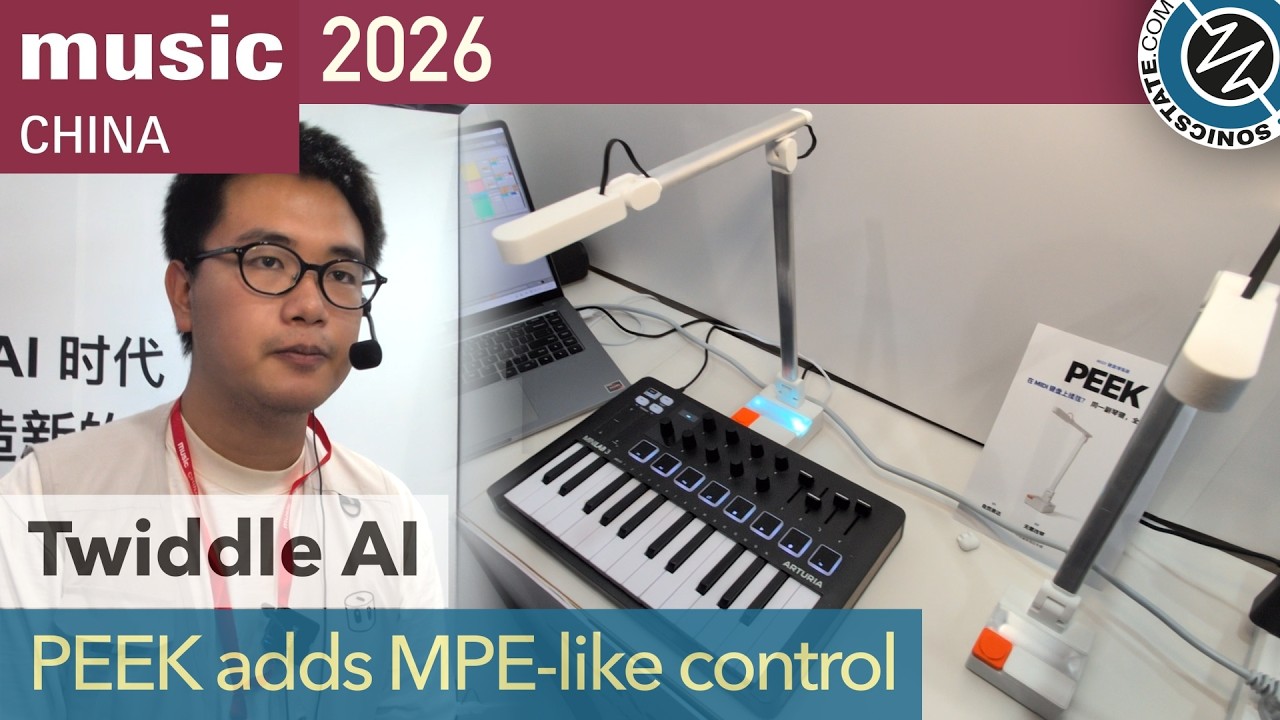
No idea if this will be good enough, and it will face the usual problems with people being skeptical, sneering, and whether it will be good enough in terms of latency and coping with stage conditions and field of view limitations.
But I keep an eye on this stuff because I expect there may be potential to add the missing slide gesture to the likes of Osmose via this sort of approach eventually, although again I make no claims with regards this particular device. In my mind I sort of have an assumption that eventually realtime image processing will enable even suboptimal camera angles, conditions etc to be able to offer a clean enough signal to make this sort of approach even more viable, but Ive absolutely no idea how many years that might take and perhaps other types of sensor will always have the edge.
When ROLI did their Leap Motion based stuff I was hoping they might lean in that direction, but of course they had a diffeent sort of gimmick in mind and had all their usual problems as a company with huge debt etc to contend with.
Demo isnt really good enough in this particular video either, especially not the rotation aspect, so Im mostly just keeping an eye on the moving up and down a key aspect.
ah, seems very viable, the angle I think can often be dealt with just by having the camera higher. and having limitations (e.g. certainly light conditions) can be fine, doesn’t have to be perfect, just reliable.
I don’t think it’ll replace anything, as I think for instrument control the tactile feedback is useful…
but it’ll have its niche ,I think main issue, a bit like Leap Motion, is if there is enough of a market for it to happen. esp, as its likely viable to code this for an iPhone, then you just need a stand.
then again, perhaps if its cheap enough, and is a standalone solution…
i.e. you plug a midi keyboard into it, and its a usb/midi output and it then outputs MPE… so no computer involved, perhaps thats cool.
I might buy it, dependent on price, could use my Virus Keyboard, into my Eagan Matrix Module… though, even saying that, feels niche
Yeah, hard to predict exactly, other than the fact it will be a niche. And we’d need to understand what targets they were setting to achieve their version of sustainability. Leap failed most obviously because they ‘did a ROLI’, many tens of millions raised in funding, setting the bar to company sustainability at a level that was always going to be hard or impossible to achieve and required them to go big time mainstream or at least have some very strong partnerships that flourished rather than floundered early. I wont go through the entire Leap history here, I think I can probably get away with quoting a single sentence from the wikipedia page about them to illustrate my point “In March 2014, it was reported in TechCrunch that roughly 500,000 units had been sold, far short of initial expectations”
I wont try to predict this particular products own challenges, other than saying that I think it will need to be cheap in the way he hinted at in the video, because it looks cheap. ROLI made their share of mistakes when designing and implementing products, especially in the longer term when it came to software/firmware updates and probably not keeping product return rates to a sustainable level, but they did throw money at the visual styling side of things. This is very different in that respect.
Nice
This has some slight overlap with what I am working on for the last few months. But it is also different. Mine will be a phone app (based on one to three phones for redundancy and depth information) that works without any MIDI controller, just with a flat (or drawn playing surface) surface. Or in combination with existing MIDI controllers. On the one hand to extend the z dimension into the air. But mainly to allow mapping of sounds to fingers. So no more need for key zone splits, you can have e.g. a voice synth with ahs on your index finger, ohs on your ring finger of the right hand and some bass on the fingers of the left hand. And when you want a C4 ahh you play it with the index finger and a C4 ooh with the ring finger. The main advantage of this combo is that the controller can take over the actual finger tracking in that mode, so the (sometimes still error prone) handtracking is mainly needed to identify which finger has touched the surface.
I guess when you have to buy the hardware this can be challenging to justify. And a capable phone costs about as much as a Linnstrument, which might be the better investment when aiming for a musical instrument. But on the other hand, when you have that phone(s) already anyways…
wasn’t leap, a bit like sensel morph - a kind of tech demo, that they hope to sell the tech into things like laptops. the electronic music applications were a very small part of the vision. interestingly, leap motion did have some success in the diy head tracking market, but that didn’t turn into anything, as vr headset manufactures already had thier own solutions.
I guess, that’s where it’d be interesting to get some number for Roli Airwave, as that was clearly focused in this area, at a ‘reasonable’ (not outstanding) price… thats said, I think many of us were a bit sceptical of Roli at that point, so I can imagine, that would have impacted sales quite a bit.
who knows, personally, I think I’d need it to be a standalone solution, if you start requiring other hardware (midi interfaces, laptops), that starts to get a bit messy for a musical application.
anyway, Id certainly not write this tech off, im sure someone will bring it to market (as Roli did), then we will see how popular it is.
one thing from an art side Id like to see more of, is tracking for dancers etc… as mimu gloves did, I think that’s a really compelling area, where you dont want to be ‘connected’ to something.
I have the Roli Airwave. The official hardware is focussed on adding some air expressions. But I guess a lot more could be done. Not worth to write an app just for it now that it is unavailable, I might experiment with reverse engineering the protocol and building an experimental version of my app for it. But that would only be internal, don’t want to get into issues. And it would be frustrating for people when they cannot buy a new one anyways.
VR headsets or AR glasses are a natural second option regarding the avaiability of suitable cameras (and an already calibrated handtracking system). Think this is a low hanging fruit to also support, e.g. Geert already showed that it works conceptually. But even though nice for experiments I am not sure how many will actually want to play with e.g. a Meta Quest 3 on their head for a longer time… But these glasses also get lighter and public apparence-compatible. So could also become an interesting option to utilize hardware that people originally buy for other purposes but can also use it as an expressive music controller.
I think the Leap stuff was aiming at both, and the fact the 500,000 units sold was far below expectations implies they had gigantic ambitions for their own product in addition to getting laptop manufacturers onboard, far in excess of what Sensel did with treating their own Morph product as a demo. And I suppose you have to have ambitions that big when you raise that much money from investors.
The VR stuff was probably a later pivot, one that required VR to go more mainstream than it has, in addition to whatever issues they had with competition.
For sure the music side of things with both of those was just an aside, they both involved solutions searching for a purpose, for one or more ‘killer apps’. At least companies with more modest ambitions that focus on specific music products at the centre of their offering dont have a desperate search for killer apps at the heart of their gamble.
Not to mention the millions the first ROLI company owed their manufacturing partner when they collapsed the first time likely impacted their ability to manufacture at scale, and they probably burnt some retail bridges too. Even people who didnt know or care about the history had to endure the whole pre-order and batch manufacturing thing, and it sounded like the 2nd incarnation of ROLI struggled to fulfil a fair proportion of customer orders within the claimed timeframes, or in some cases at all.