Technobear's Eigenharp developer blog

I thought I’d try something a bit different…

at any any point in time, Ive usually got a number of development projects that Im working in many different states - they could be a concept, in development, close to release, or released… (not just Eigenharp related)

Usually, I do not talk about them, really to keep expectations in ‘check’, I don’t want people to get excited, and then I put it on the back-burner for 6-12 months… which happens a lot !
easier to just talk about when I release it

However, that means I can’t get any early feedback, or a feeling of how interesting it it to others…

now, with temperatures dropping a bit, I getting back into my ‘development season’ - so going to try a more ‘open approach’

in this topic Im going to talk about things Im working and give some idea of where they are at - but in ‘blog format’, as they are not ‘releases’

just to manage expectations…please bare in mind

a) no commitment
if Im not giving a date, that could mean, i go off and do something else for 6-12 months. similarly, Ive commitment to other features Im talking about adding/changing.
b) not released
means not supported, there will be bugs and I may not be working on it at the moment , so bugs may be months before fixing (see a)
c) concept/ideas vs real project
Im going to (try to) resist talking about future projects that are at a very early stage - though I might mention proof of concepts.

the main reason for all this is feedback

is the direction interesting? is there a lot of interest? perhaps look for some testing help?

ok, 2 following posts will be talking about un-released projects, but…

EigenD 3 (beta)

just to touch on EigenD 3 (beta), this has its own topic for more details
however, I’ve started some dev already this week on various projects, and hope to get back to this soon. (I’ve visitors next week, so will be after that)

the main thing, to get it from Beta → Release is Windows and Linux support.
(oh, and xcode release broke build ;))

Linux

Linux was ‘stalled’ on Python 3.14 release, this is now available - so this can continue.

Windows

This is quite involved, I need to sort out build tools, and also test/document the usage of libusb - as we can’t use eigenlabs drivers (no 64 bit interface).
its a big move, and like it or not, very few use windows, so its kind of meh!

anyway, thats the plan for eigend…
on to some things Ive had up my sleeves for a long while :wink:

4 Likes

ummmm… 20 characters /ideas…

1 Like

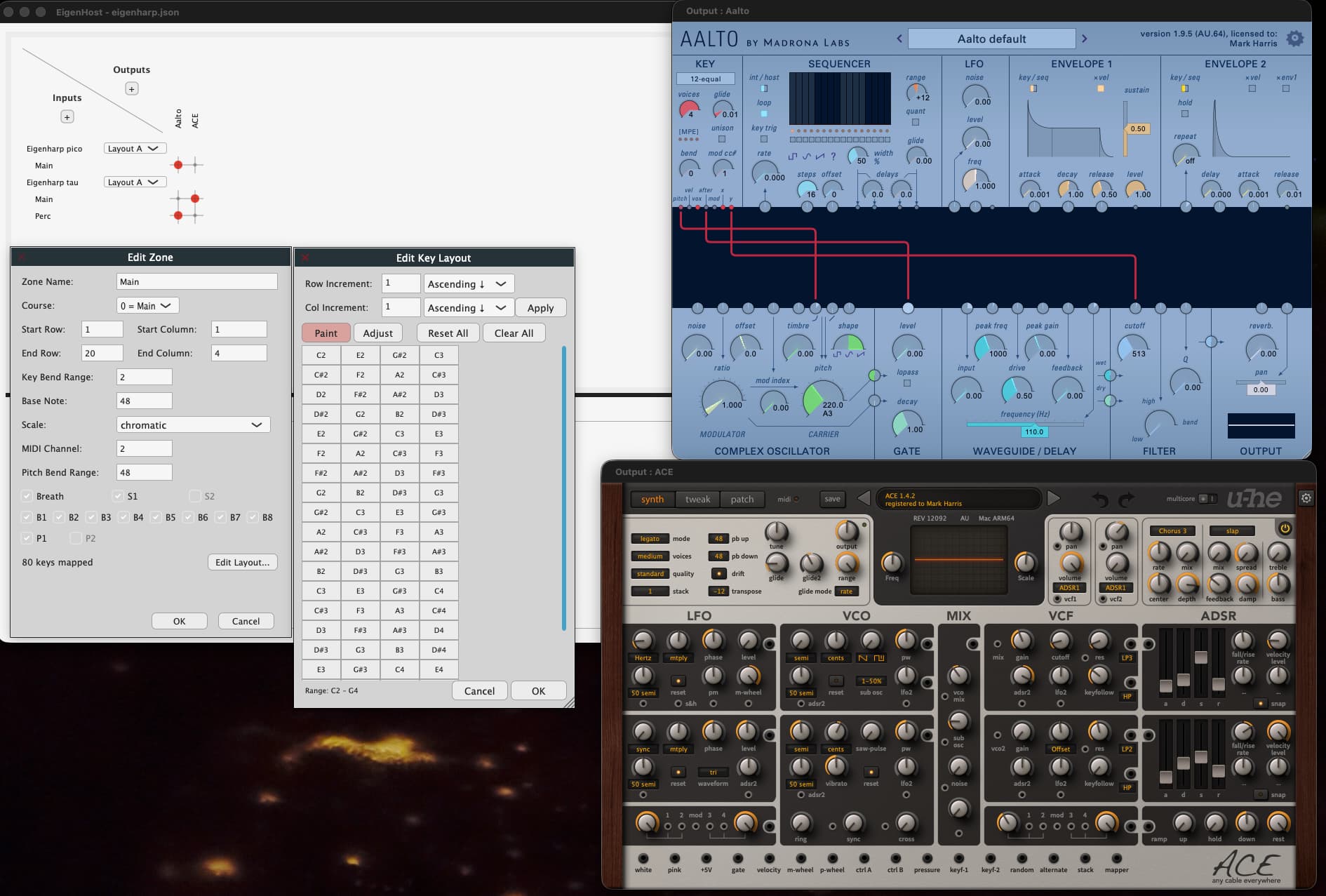
EigenHost

(working title only !)

Status: active development

its working but lacks many of the features Ive planned for it…
and UI is still a WIP

Give it a go : download link

Requirements: macOS 13.0+ / Arm

Background / Goals:

often I just want to play my Eigenharp, as an instrument… turn it on an play.
not start EigenD, start a daw, load a project… just play!

thats the start… but it soon expanded…
I wanted:

  • to host multiple vsts and output to midi devices (e.g my Osmose).
  • to have multiple have multiple inputs e.g. my Erae 2 , a keyboard, the Eigenharp Pico or Alpha.
  • to have different zones/split to go to different outputs
  • to easily change the routing
  • to have different setups switch on the fly, no delay etc.

I suspect, at the time I was playing with the Eagen Matrix and so decided that a Matrix would be a really nice ‘core’ to the whole setup.

your setup decides on what Inputs and what Outputs are available
(e.g. load VST, connect to devices )
these generally will not ‘change’ (ofc, you can have multiple setup files!) during ‘performance’, and so cpu load is stable

a particular Input then has 1 or more Zones
Zones are regions on an input, that can have characteristics, e.g. for an Eigenharp a note layouts .
Interestingly, zones can overlap… this means that different layouts (seem below) that ‘cut up’ a device in different ways.

then define ‘layouts’ (don’t worry you can just have one ;)), this defines the routing e.g. which input zone (e.g Eigenharp percussion keys, or split) goes to which output (Vst/Osmose?), and also which zones are active.

overall the idea behind layouts and zones is a bit like EigenD with keygroups.
you can have a Split 1 , a Split 2, a Split 3 layout defined in one setup (file) and quickly switch between them - no loading AND the layout also defines which output they go to.

also for non-performance fun, if you want to change which VST (etc) you want to target a zone , its a simple matter of clicking on the matrix :slight_smile:

side note:
because we are a VST host… this means all VST parameters are saved along with your setup :slight_smile:

note:
Application control, will be done via new ‘output type’ (Host Control), this is how you will map an arbitrary input device zone to control the app - as there are defined midi messages to do things like switch layout.

Current features

  • multiple Midi input , with zones
  • multiple Eigenharp, with multiple zone layouts
  • Host / Output to VSTs
  • Output to midi devices
  • Layouts

What’s missing

the following are planned, and are already in some form ‘in the code’, or partially coded
so this is what Im kind of working on…

  • Midi
    is basically fixed to MPE at this stage, but I want to have ways to fine tine the midi
  • Mixer / FX
    currently I just sum the audio outputs, and honestly thats enough most of the time, as most plugin these days have FX.
    However, I do have some favourite FX (Vahalla delay/shimmer), a shame not to include these.
    also for ‘performance’ its a must too…
  • Host / App control
    the architecture / code allows for both midi and eigenharp’s to control the app.
    the absolute minimum will be octave control, switching layouts, and toggling matrix connections.
  • Multi threaded
    this is a big part of it… and something Im working very hard on currently, to to ensure a very tight threading model, that is stable…

ok, sorry, thats a lot of waffle, but its hopefully sets the stage for what this is, and the ideas I have for it :wink:

6 Likes

eigen-gp-ext - GigPerformer Pro extension

(unimaginative dev working title :laughing: )

Background

The idea was simple, GigPerformer is a great and well proven performance environment and host - wouldn’t it be call, to just connect the Eigenharp directly into that module environment!

the core idea was to give raw access to then Eigenharp, and then leverage all of GP’s features to create the setup etc, this included using GPScript as a way to interface with the Eigenharp.

this idea goes back a LONG time, to when GP was first released.
at that time, however, GPScript was still in its infancy, so it wasn’t really viable.

But whilst working on EigenHost for some reason (Im easily distracted!?), I decided to take another look… and now its definitely viable.
so started up this project too…

first, special thanks to David Jameson , dev at GigPerformer for helping/ supporting me with this…

But, before getting hopes up,
I’m not ready to hand this out yet, as its ‘shape’ is still in flux (see below)

Status

Active development,

technically the fundamentals are already working
you load gigperformer, it connects to the eigenharp, you can configure it. set outputs etc and so ‘it works’

as EigenHost was already underway under the hood its quite similar (and ‘stole some code’ :wink: ) - with the idea you can setup zones and then have it target various outputs e.g. midi or osc.

Ideas, whats next etc?

currently, it doesn’t really have a (real) UI (it will do), instead, you configure everything using GPScript.

This is a ‘fundamental’ aspect I wanted for this project,
that the setup was largely control in GPScript and I’d give examples to show how to setup.

What I love about scripts is, they are saved by GP with your setups, and also you can really easily edit/manage them.
also with a broad enough script API, you lean on the many features of GP to handle the control aspects.

finally, these days with AI / ChatGPT etc…
you can tell them what you want and get them to create them to create script for you.
(we can have a ‘template context’ so that the AI knows enough to do this)

the lack of a (real) UI, and what functions and parameters the script API has,
is the ‘shape’ thats still a bit in flux… so whilst not ready to come into the light yet…

but its close and I do want it out in some form sooner rather than later, as I may need more feedback, and help on this one.

frankly, I’ve not used GP that much,
so whilst, I know my way around, Im far from a power user, especially with GPScript.

my hope is :

  • finalise some my thoughts and make a few decisions on the ‘shape’,
  • put out an early version
  • gets some thoughts from those that use GP a lot, on the next steps…

does it even need a UI? if so , what?
is the integration with GPScript too complex?
given the integration via GPScript, does this it and GP provide what you need?

so its quite close really… before I have that ‘minimal viable’ version.

anyways, I know a few of you really love GigPerformer, so Im sure this will be interesting to you :slight_smile:

(unlike EigenHost which no one asked for :laughing: )

3 Likes

uupss sorry I don’t have nothing on latest macosx…

Mac Studio -M1 Max 2022 (Sequoia 15.8.1)

MBP M1Pro 2021 - (Sonoma 14.8.9) (for live shows)

1 Like

ah, is the build only working on Tahoe? do you get an error saying that?

I think its likely, xcode/cmake just defaults to the version im building on.
so I’ll see if I can build with an earlier min version, something like Sonoma should be fine.

note: there could be some oddities, as I only have Tahoe here to test on, I try to keep reasonably up to date.

I’ll post an update tommorow.

1 Like

Back working this winter, so a little less time to play, but as soon as I can find some time, EigenHost is something I’d like to take a look at!

ok, Ive updated the original link., this should now work with macOS >= 11.0

known issues:

  • occasionally hangs on exit
  • sometimes Eigenharp connects, but seems not to be processing messages.
  • I’ve only ‘tested’ it on Tahoe, so older versions may have other issues.

I believe both of these are caused by some rework thats on-going on multi thread protection , and possibly also a recent lifecycle change.

at this stage, this is more a ‘taster’ for those interested to take a look, see its direction… even more interesting when I add the ‘host control’ features, so see whats need etc

generally, don’t worry about testing / bugs, the code is in a bit of flux, so its not a reflection of its underlying state/stability. so its a bit of a waste of time testing it. It’ll, ofc, be fully tested top to bottom before release :wink:

next steps:
Ive not touched it for a while, so I need to get up to speed about where I was, in particular on this ‘refactor’ - that includes fixing a few unit tests it broke.
(unit tests breaking = good, means they are doing their job :slight_smile: )
so thats priority one… fixing that, and deciding if I need to carry on down that route and how far.

functionally, next step is more work on host control, basics are in place… just need to hook up a few things. this’ll likely be a first iteration a proof of concept.
so, that’ll likely be next ‘EA release’ to gather some feedback on .

2 Likes

WOW… yesterday was in a hurry and just read that first part; now ** GigPerformer Pro extension** I’m all over it !!

2 Likes

EigenLite

(mostly interesting to @Kai for ECMappers. but potentially others)

EigenLite is the foundation of all this stuff, its my API, that talks to all Eigenharps, and integrates into ‘3rd party apps’.

this does have its own topic, which needs updating :laughing:

in context of this blog, I thought id update a little whats going on it it…

I work on EigenLite in parallel to a ‘client project’, so things like EigenHost. usually, because these expose a better way for the api to work.

I, currently, don’t really version / release EigenLite in the way you do an app, because its for developers, and so they basically see a snapshot of it when they are actively working with it. they can update when they want (or not).
this is a pragmatic approach, which Im happy to change if needed…

anyways, the interesting bit is about recent changes…

Lifecycle callback

this was introduced to help apps have ‘manager’ classes that are responsible for knowing the state of eigenharps connected, and then delegate the actual processing to other ‘connection’ classes

I’m still not 100% happy about the whole device filtering etc.
I may push this further at some point so the Callback is for a particular device, to ease further the burden of apps having to track devices.

Testing - Capture/Replay API

Currently, EigenLite does not have any unit tests, these are within EigenHost.
(though possibly some of these could/should be moved?! need to review!)

However, EigenLite now has an new additional api to aid testing.
a ‘replay/capture’ api.
the idea is very simple, with this api - you can capture an eigenharps messages (at eigenapi level), store in ‘capture file’ (.elcf format), and then later replay them.

this means that you are able to record an Eigenharp being connecting, sending notes, etc - and then use this capture file to drive units test for your app to test/retest functionality etc.

example:
EigenHost has unit tests that check that the midi created for a particular capture file is correct.

Also, Im able to use this to create unit tests that ensure EigenApi itself is acting as I expect it too, that Ive not introduce a new bug etc.

AI usage

I’ve mentioned previously, Ive been exploring the use of AI for quite a long time now… not for ‘vibe’ coding, but rather, exploring how it can be used as a tool for experienced developer.
as a ‘fresh’’ project EigenHost has allowed me, for good n’ bad, to do this at a a new level (as I was not concerned with ‘tainting existing code’)

two areas, Ive found really useful (and how replay api got created)

  • documentation
    very few developers are working on any of these code, so time investment documenting is pretty ‘poor value’.
    but AI can really help this area , I don’t need to write, and can rather just generate and then review (for correctness), and its easy to update!
  • unit testing
    similar to documentation, unit testing has a pretty large overhead, even though its very beneficial it can be hard to justify the extra effort. AI can help reduce the overhead.

note:
I should say in both cases. this is not ‘free’ (in $ or time investment), its a tool - it doesn’t magically do the work, you have to work with it, review it, refine it, and also often ‘step in’ to get it going in the right direction…
This is kind of cool, it does not replace experience, rather it leverages it!

Future : Headphone / Microphone support

@Kai recently did some cool work in this area to add support for this for ECMapper.
It’s a bit of a change in direction for EigenApi which I wanted to be ‘lightweight’ and not require an audio dsp loop - but it is definitely a cool and useful addition.
my plan is to review this, and see we can get this into the api :slight_smile:

1 Like

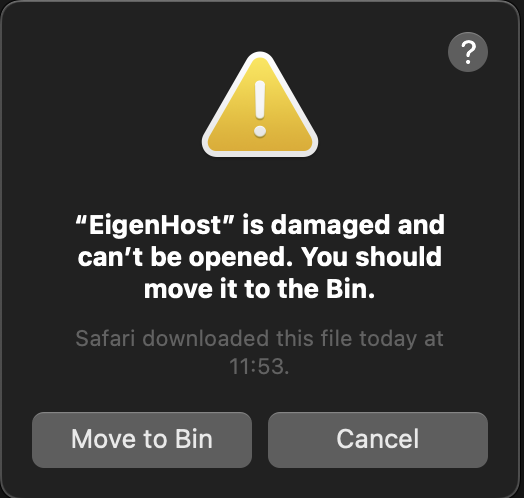
still no go…??
Screenshot 2026-10-07 at 12.24.43

Perhaps a signature issue with Apple warning dialog formulations getting more discouraging with every macOS version?

Does this help?
xattr -r -d com.apple.quarantine PATH_TO_APP

Im looking into it and can reproduce when copying to laptop. indeed its signing or gatekeeper issue… please wait …

1 Like

I’ve been working with AI coding quite a bit this year (through GitHub copilot via opencode/omo). It’s a powerful tool, and I agree that it’s very helpful with some of the tasks that developers have been “lazy” about.

Have you added agent files into the repo? To what extent can you ask for a feature at a very high level and get something useful? eg. if EigenD agent creation possible from a feature description?

1 Like

ok, should now be working (updated link above), at least is when I download it.
just apple tightening things up… you’ll now be ‘warned’ and can use ‘open anyway’ as before.

note: Ive updated to min 13.0, just because thats what picodecoder currently is, if we need 11.0 - then I’ll need to rebuild that as well.


yeah, its a really interesting area - Ive my ‘fears’ for new devs (dumbing down)
but for experienced devs - it can be really powerful!

so, within EigenD etc, Ive been leaving files around that will help AI agents, things like how to build, architecture docs, testing etc.

Ive was thinking about the EigenD agents the other day.

for Percussa SSP/XMX and also the 4MS MetaModule Ive a couple of projects that allow end-users to create ‘virtual modules’ using MAX RNBO.
this doesn’t use AI, but rather scripting/templating based on some of my own code… but I used AI to make the scripts a bit more ‘user friendly’ :slight_smile:
this approach could very likely work for EigenD agents, and is relatively simple.

But I was wondering about using LLMs to actually full create the code.
I know some have done this for the 4ms MM.
It seems to work, I think if you are reasonably good at creating prompts.
for EigenD, it’d simply be a matter creating the documentation of ‘how to create an agent’, and what the api is … we have a few simple agents so thats not really an issue…

probably another useful step would be to move some of this outside of the EigenD repo
a) so you dont end up buidling the whole EigenD repo for your agent
b) the LLM doesnt start searching the entire EigenD code base :wink:

this shouldn’t be hard, as this was already possible.
so it more like creating a ‘template repo’ with the required ‘bits’ that users can then fork.

tl;dr; its probably not 100% there, but very close, and probably just needs a bit of tinkering to tidy it up.

3 Likes

I have done this for some projects now. One is a musical application that is hopefully ready soon, the other a CAD design for a musical instrument (with agentcad+FEA+custom UI that e.g. gives you a BOM+a list of needed CNC bits for a given configuration). And a computer game with non-trivial multiplayer, level editor (with logics nodes and expression definitions) and code generator for another game (so the level editor can be used for that one, too). (https://sh0.eu).
And also more and more at work. (There we at least still review everything that the LLM generates, my hobby stuff is mostly tested, not reviewed on a code level anymore). But I agree with Mark, it still makes a lot of a difference whether you have previous experience or not. Perhaps you could see the LLM like an external contractor. He is good, perhaps knows more than me in his field of expertise. But he won’t be around indefinitely, so our dev team has to comprehend and “inherit” the code, so it is important to ensure that the code stays comprehensible. What is needed for that can differ between people, they have to tell the LLM which structure or infos they need to be able to comprehend this.
But I also think that it will be harder for new generations when they are reliant on the agents doing the right thing because all they can do is to ask another agent to do the review for them. Probably it is important to still do things manually from time to time not because the LLM couldn’t do it but because one might lose the ability otherwise - or not develop it in the first place.

2 Likes

exactly…
the issue is coding is a practical skill, you learn by doing it, and also by doing it wrong… learning from your mistakes is important.

as you say, agents are like contractors, so you are moving yourself more into a ‘managerial’ role…
anyone thats worked with professional managers with no coding experience will know the issues that creates for teams.
what happens is, they tend to lean on their experienced coders… but in this case, as you say… that might end up being yet another LLM !

don’t get me wrong, Im no luddite… all industries, all careers change over time, as technology progresses.

Ive little fear in a doomsday scenario, and also the talents for new generations will be just ‘different’ (not less)

however, low level coding is fun as a career, and I think there will be many less opportunities to enjoy it (its already been on a downward spiral due to IDEs etc)

its a bit like, its one thing to be a draughtsman / architect with pencil and a board, and a CAD based version - both are skilful, but they are different, and the former is rare these days.

3 Likes

Wow, the new projects sound great! Ok, my feedback:

EigenD 3.0 - Feels like an important milestone, but at the same time I don’t really use EigenD myself anymore. I bet it is a big deal for most Eigenharp owners, though?

EigenD 3 Windows libusb - I’m primarily windows, but haven’t run EigenD in Windows in ages. I assume that work is transferrable to EigenLite later on? If so, “indirectly” still very interesting work to me.

EigenHost - Exciting! I too want a “low-friction” pick up and play option. I have already given it a spin and like where you are going with it. 95% of the time I spend playing I just want to practice or jam in my usual configuration. I don’t feel the need for tons of features for me to use this regularly. Creative, elaborate setups can be fun, but we have many options for that stuff. And often it feels like a chore to have to deal with all that stuff. Initial thoughts are that fixed MPE, summed outputs, no effects all sound fine to me.

eigen-gp-ext - I love GigPerformer, partly because of GPScript. I use both a lot. So, obviously intrigued. I’d probably be happy with a UI-free version if a layout could be created in EigenHost, say, and then be saved as a GPScript. ECMapper + GigPerfomer happens to already cover my specific needs (for obvious reasons!), but I would enjoy experimenting. I probably don’t ‘need’ this, but I still want it. :wink:

EigenLite - I am very happy with EigenLite. I found v1.0 to be really easy to work with. I’m sure you know areas that can be improved, but I have no complaints. Audio added “properly” is no hurry on my part, but cool to have eventually so I can get rid of my fork. I am tempted to dig into the Windows libusb stuff in an attempt to help out, but I suspect it is best I leave it to the pro. I have no prior experience with that.

1 Like

Totally agree. When you have the chops acquired the hard way over time, you know how to spot the issues with the code, know what good code looks like, … But you build that knowledge by doing things the hard way, and making mistakes. What happens to the next generation is anyone’s guess. Maybe the skill will morph to crafting good prompts, and the agents will be good enough. I suspect it’s too early to tell.

In terms of new agents, I’ve wanted to turn my Alpha into something that could run an mlr clone for many years, ie. add something that looks like the arranger, and have the ability to play, slice up, and repitch loops (maybe even also create those samples from audio in). It’s well beyond my ability to do by hand, but with an LLM help maybe not so far out of reach?

1 Like

ironically, it may well be the other way around :laughing:

I did have this ‘working’ a long time ago, with a quick build I hacked together for EigenD,
and the main tricky bit was using the correct libusb software on windows and setting it up.
so this time around I need to take some notes as I do this, so I can create a bit of a guide.
(what to install, what the settings need to be)

but its likely going to be quicker to get a build of EigenHost compiling for windows to do that ground work than EigenD…

at the moment, Im trying to cross compile windows binaries on linux which is proving ‘fun’.
Im nearly there just a problem with msvc and clang not playing nicely about who is going to provide the SSE intrinsics :wink: .
… well I say nearly, Ive been banging my head against that ‘nearly’ wall for many hours now…

EigenD is just a matter of compiler flags, I already notionally have in place.
however, Ive torn apart the windows build system, as it was archaic, and Im trying to find a better way (hopefully this linux cross compiling )

1 Like